Derive: Scaling the Largest Onchain Options Exchange with Celestia

This case study explores Derive, an onchain options exchange that accounts for 95% of onchain premium volume at the time of writing, and why it chose to build on Celestia.
Derive: the largest onchain options venue
Derive is an onchain options exchange built for professional traders, market makers, and funds. It supports options, perpetual futures, and block trades through a request-for-quote (RFQ) system, with portfolio margin across more than 20 collateral types.
As of October 2026, Derive is the largest onchain options venue, accounting for about 95% of onchain options premium volume and having processed over $40B in cumulative notional volume.
How Derive works
Derive recently launched V3, a major upgrade to support its next chapter of rapid growth with three key advantages over their previous design:
- Capacity: an order-of-magnitude increase in throughput
- Custody: Ethereum-native custody, validity-proven state, and an escape hatch on L1
- Speed: faster market listings and product launches due to a simpler architecture
Derive V3 achieves this by splitting the exchange into four layers:
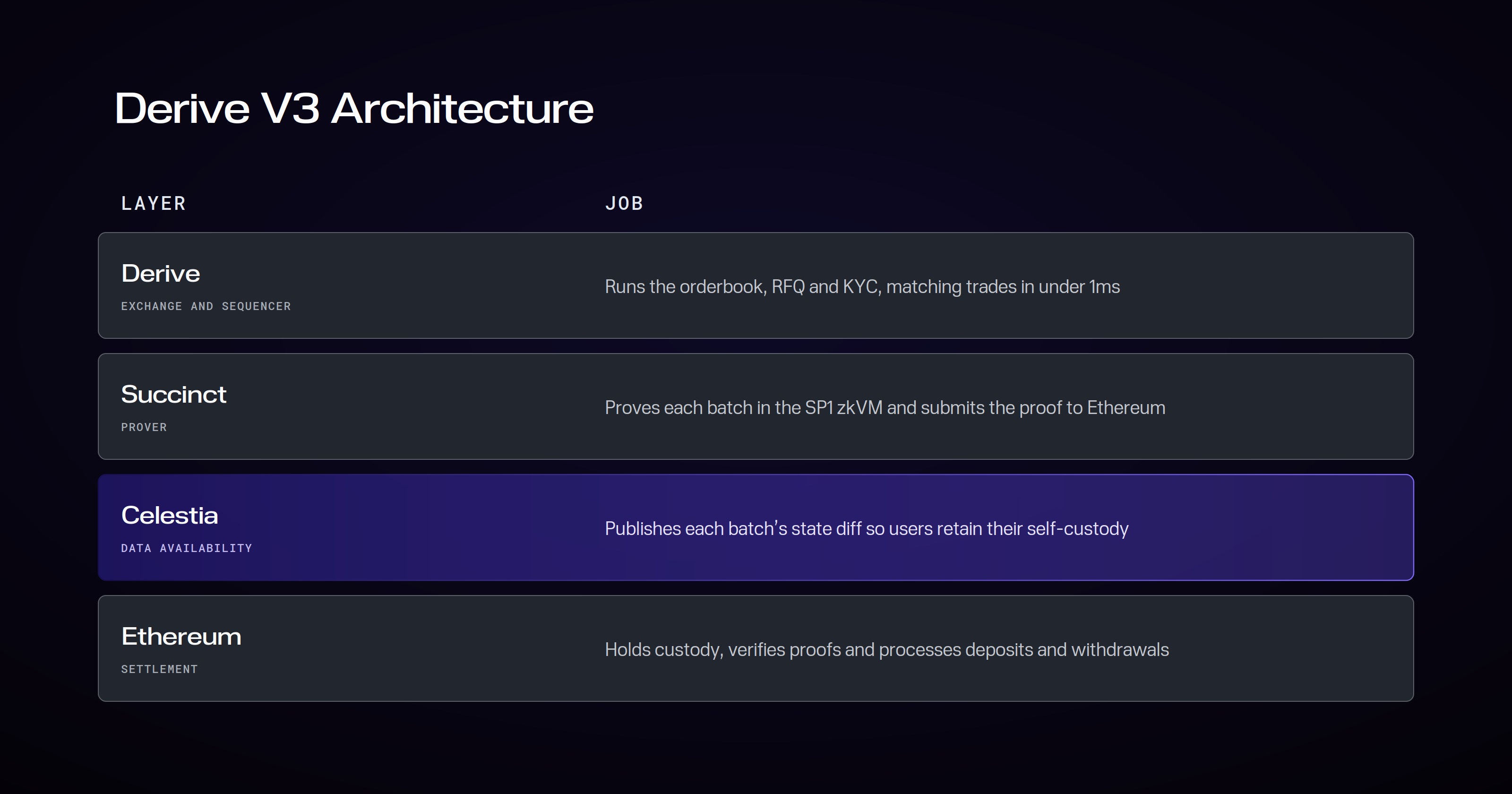
Thanks to the V3 upgrade, Derive can now handle thousands of positions cross-margined in a single portfolio, and continue matching orders during a market-wide spike. Easier integration support also means that more wallets can offer deals like "protect my ETH below $3,000," and more yield products can offer "earn while willing to sell at $6,000," powered under the hood by Derive.
What Celestia provides
Celestia ensures that user funds are safe in case the Derive operator goes offline or becomes malicious.
The validity proofs prove to Ethereum that a batch of changes is valid, but they do not tell anyone what those changes are. If the only copy of that data sat in Derive's database, a user would not be able to check their balance or withdraw if Derive went offline.
To fix this, every batch's state diff is published to Celestia, which provides two important guarantees:
Users retain their self-custody without Derive: The data needed to rebuild the full exchange state is public. Derive's database becomes a convenience instead of a dependency because if Derive went offline tomorrow, a user’s funds would still be sitting in the Ethereum contracts, and the data to prove what they are owed would still be on Celestia. They could withdraw without Derive’s permission, and even without Derive existing.
Anyone can take over settlement: The Ethereum contracts force the sequencer to process withdrawals in the order they arrive. If one sits unprocessed for two weeks, anyone can fetch the data from Celestia, run Derive’s exchange binary and propose new batches. Withdrawals continue to flow even without Derive's cooperation.
Why Derive uses Celestia
"Celestia provides the highest potential scale, economic predictability and infrastructure maturity.
The speed of putting the Celestia client in the zkVM program was substantially simpler than we had thought. This would have taken a lot longer with Ethereum DA, particularly estimating gas costs."
- Josh Kim, CTO at Derive
Derive has been using Celestia since January 2024, with 43,082 blobs and 42.52 GiB in its namespace so far. When upgrading to V3, Derive is continuing to use Celestia for three reasons:
Predictable fees: Applications like Derive need predictable operating costs to ensure their economic model works, and one of their input costs is data availability fees.
Fees from alternative data availability providers fluctuate significantly over time depending on network congestion, making operating costs hard to forecast. Celestia’s fees have remained stable since launch because the network continues to scale and avoid congestion.
With 150 MB/s of capacity on Celestia mainnet and a robust scaling roadmap, Derive can rest assured that Celestia’s fees will remain stable into the future and Derive’s DA costs will remain predictable.
Room to scale: V3 increases Derive’s throughput capacity on the exchange by an order of magnitude, but that only matters if the data layer underneath can keep up. Fortunately, Celestia recently upgraded to Fibre which raised its throughput to 150 MB/s on mainnet and demonstrated the ability to hit 3 Tb/s in a recent benchmark.At Derive’s current rates, they could increase their data consumption by many orders of magnitude before hitting Celestia’s limits. This gives them ample headroom to scale their exchange in V3 and in the future.
Easy integration: In Derive’s design, a valid proof must verify the inclusion of the state diff data on Celestia. This means implementing a client of the DA layer within Derive’s zkVM program, which can be extremely difficult. Celestia’s pre-built Rust client made this integration work simple and straightforward.
Looking ahead
Celestia Labs is excited to continue supporting Derive as it builds the next generation of onchain options on V3 and beyond. As more of global finance moves onchain, Derive and other onchain markets can count on Celestia to help protect their users’ funds with cheap, reliable, and scalable data availability.
If you are building an exchange, a payments system, or any onchain financial product that requires extreme scale, let’s talk.