Relay Chain: A Case Study in Product-Centric Chain Architecture

This case study explores Relay, an onchain interoperability product that scaled to broad adoption (100M+ transactions, and $20B+ in volume across 85+ chains) and why it built its own chain to settle it all.
What is Relay
Relay is a multichain payments network that allows users to spend any digital asset to transact on any blockchain, instantly.
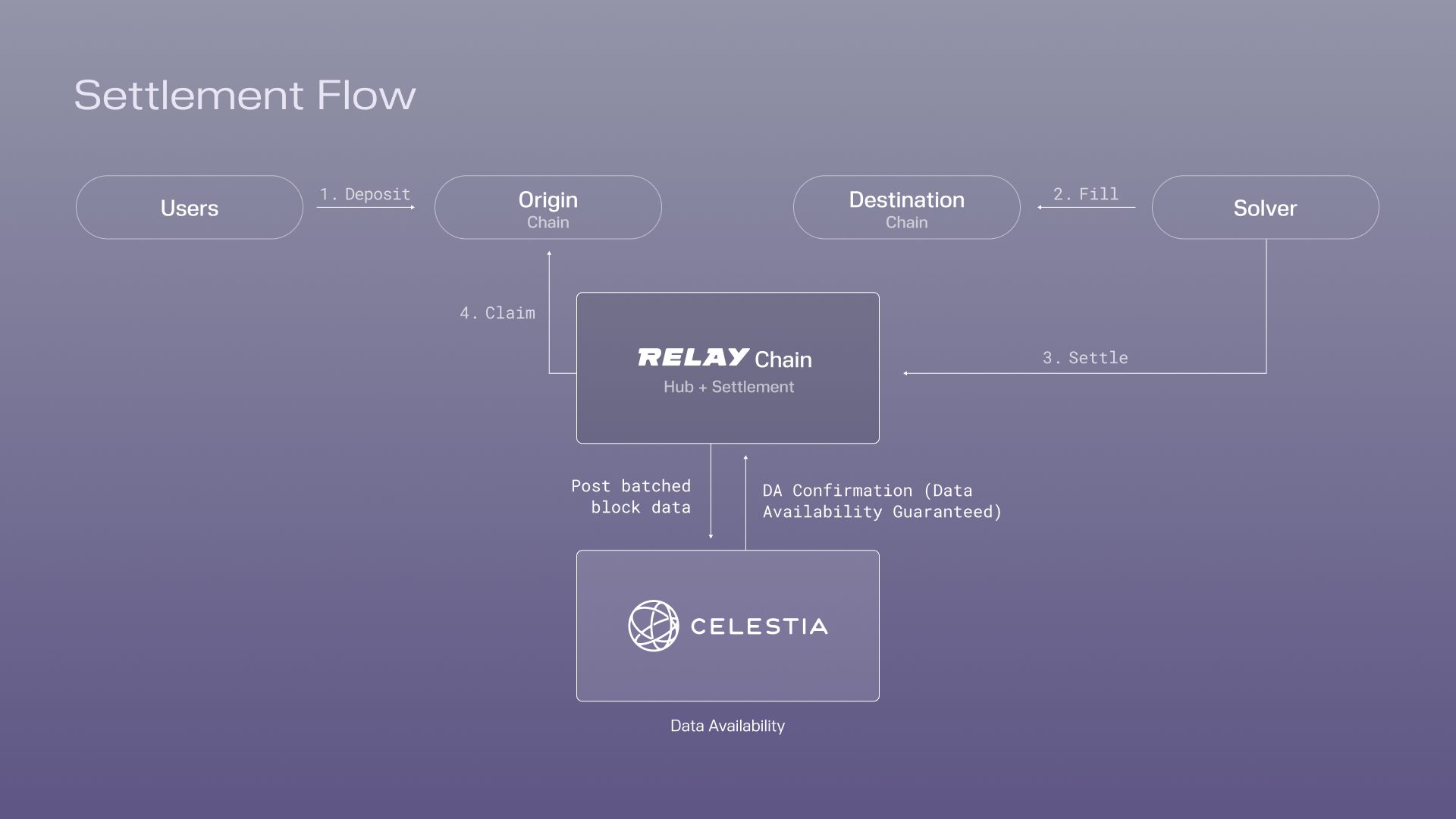
Relay uses an intent-based model: a user expresses what they want (e.g., swap ETH on Ethereum for USDC on Base), relayers compete to fill the order by fronting capital on the destination chain, and the user gets funds in seconds. Settlement (the validation and reconciliation of the transactions) happens asynchronously on a cheaper layer: Relay Chain.
Relay Chain is a bespoke blockchain that serves as Relay's dedicated settlement layer. Announced alongside Relay's $17M Series B led by Archetype and Union Square Ventures, it is infrastructure specifically designed to settle every crosschain order individually, reduce settlement costs, and give solvers a single venue to concentrate liquidity.
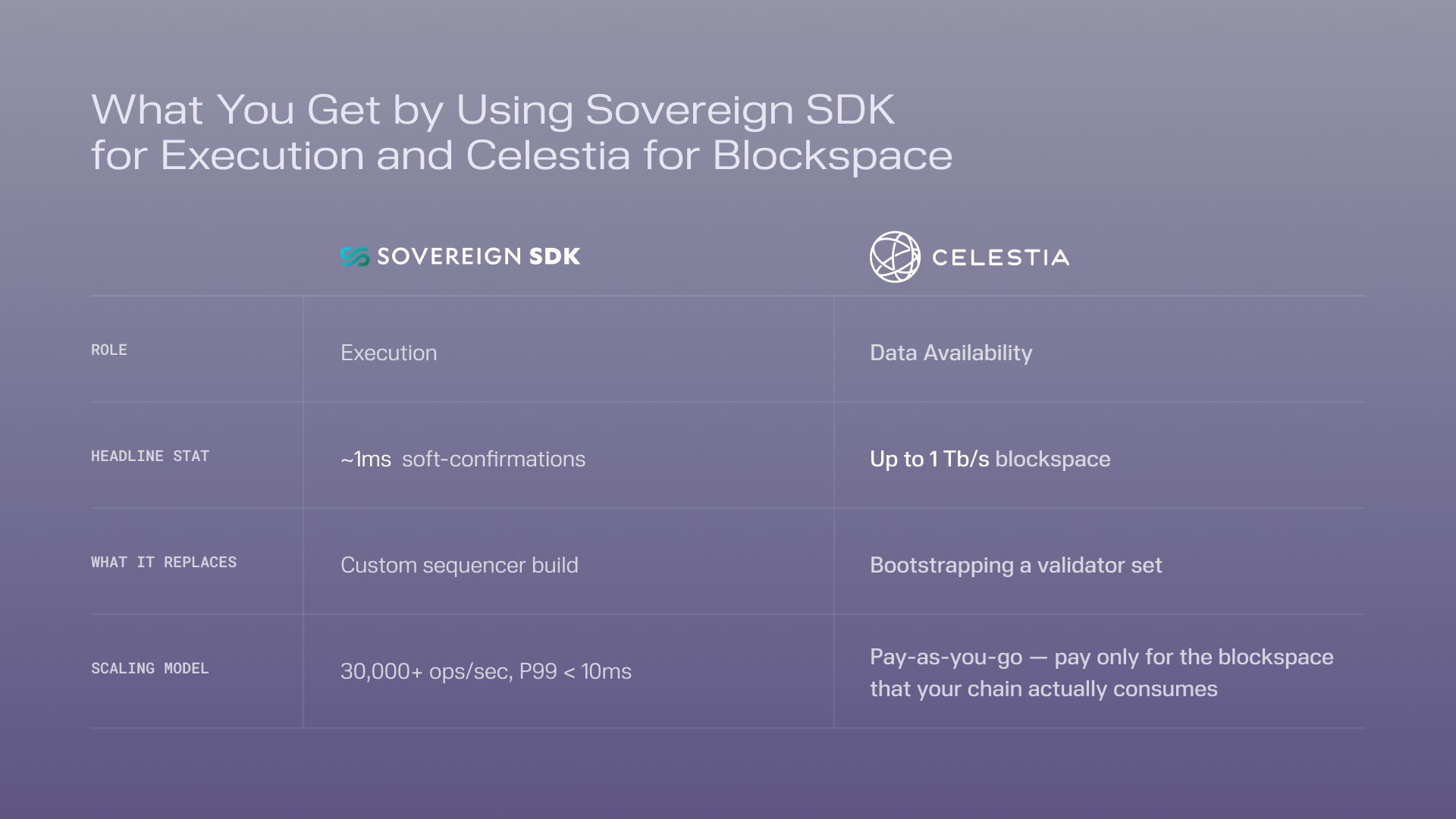
Relay Chain is built using Sovereign SDK on top of Celestia. This pairs a high-performance sequencer (~1ms soft-confirmations) with Celestia's high-throughput blockspace layer, delivering the speed and cost profile of a production-grade settlement chain with large distribution demands.
Why a dedicated chain
Before Relay Chain, settlement happened on existing chains that Relay services, which subjected Relay to those chains’ congestion, gas costs, and throughput limits. As Relay scaled toward tens of millions of transactions, this setup introduced bottlenecks:
- gas costs eroded profitability,
- batching to save costs added latency, and
- solver capital fragmented across dozens of networks.
Relay Chain solves this with a dedicated environment where settlement is extremely cheap (enabling per-order settlement instead of batching), solvers concentrate capital on one chain, and the execution environment is purely optimised end-to-end for settlement.
Product-first chain design
Relay built their product first, served millions of users, processed billions in volume, and only built a chain after feeling the friction from having to settle on other chains. The chain was the inevitable conclusion of Relay’s scaling needs.
The result is a lean, sovereign rollup: a sequencer that handles ordering and execution, and posts data to Celestia for verifiability, where any full node can independently verify state transitions.
This design allows them to do away with:
- Blockspace contention: Relay does not have to compete with unrelated apps for throughput or gas pricing as their chain services only their needs
- Expensive validator sets: validator sets take months to bootstrap and can cost billions in issuance per year to maintain
- Latency constraints: without their product-specific chain, Relay would be prone to settlement latency that locks up solver capital and degrades pricing
- Unpredictable settlement costs: on Relay Chain, settlement is ~$0.005/order regardless of what's happening on origin/destination chains
- Fragmented settlement logic: instead of maintaining separate settlement contracts and proof verification on every origin chain, everything converges in one place
- Dependency on third-party upgrade cycles: Relay can control their own execution environment and can iterate as fast as the product evolves without having to wait on another chain's governance
and other infrastructure overhead that comes with general-purpose / shared chains.
Where Celestia comes in
Sovereign SDK:
Relay chose Sovereign SDK after evaluating it against competing frameworks for lowest error rate, lowest latency, and fastest responsiveness. Performance: ~1ms soft-confirmations, P99 under 10ms, 30,000+ user ops/second. Developers build in standard Rust and get a full-node implementation out of the box.
Celestia Blockspace (Data Availability):
Relay Chain's sequencer produces blocks at millisecond speed, which are then batched and posted to Celestia as raw data. Celestia's validators provide consensus and data availability, making it possible for any Relay Chain full node to re-execute and verify state transitions. Celestia doesn't interpret or execute Relay Chain's data, it only ensures data is available and ordered. Relay Chain gets blockchain-grade verifiability without the overhead of bootstrapping and maintaining its own validator set.
By outsourcing blockspace to Celestia, Relay Chain turns infrastructure into a pay-as-you-go utility. If Relay Chain chose to bootstrap their own validator set for their chain, every validator must be sized for peak traffic at all times. When throughput grows, someone has to coordinate hardware upgrades across the entire network. Relay skips all of that by using Celestia for blockspace.
When Relay Chain’s usage spikes, only the blockspace (data availability) usage bill goes up that month, without requiring additional coordination or communication across the validator set. No reprovisioning, no coordination, no engineering time lost to infrastructure. And with Celestia's Fibre protocol delivering up to 1 Tb/s of blockspace, Relay Chain has headroom to scale orders of magnitude beyond current volumes without ever hitting a blockspace ceiling. Relay's team stays focused on the product.
Key takeaway
Relay Chain demonstrates the power of product-centric chain development on Celestia. Build the product first and then build the chain when the product demands it. Use Celestia for verifiable blockspace (data availability) without all the additional overhead required by bootstrapping a standalone L1: the leanest and fastest way to bring a product onchain.