Introducing Fibre: 1Tb/s of blockspace


Today, we’re closing the chapter on throughput.
Celestia is introducing Fibre Blockspace, a new data availability protocol capable of sustaining 1Tb/s of blockspace across 500 nodes. That’s 1500x the throughput goal we set in our original roadmap over a year ago.
Introducing Fibre
The last decade of crypto market design can be described in three bandwidth regimes:
1. 10KB/s - AMM era
Enough for AMM-based spot markets on monolithic L1s, such as Uniswap.
2. 1 - 10MB/s - onchain orderbook era
Enough for crypto-to-crypto CLOBs and perps DEXes, such as Hyperliquid and Bullet.
3. 1GB/s - 1Tb/s - “everything markets” era
Enough to put every market onchain, not just crypto-to-crypto markets, including markets that write for every agent action, impression or crawl. This is where Fibre takes us.
If 10KB/s enabled AMMs, and 10MB/s enabled onchain orderbooks, then 1Tb/s is the leap that enables every market to come onchain - roughly 1 transaction per second for every human on earth, or for every agent they own.
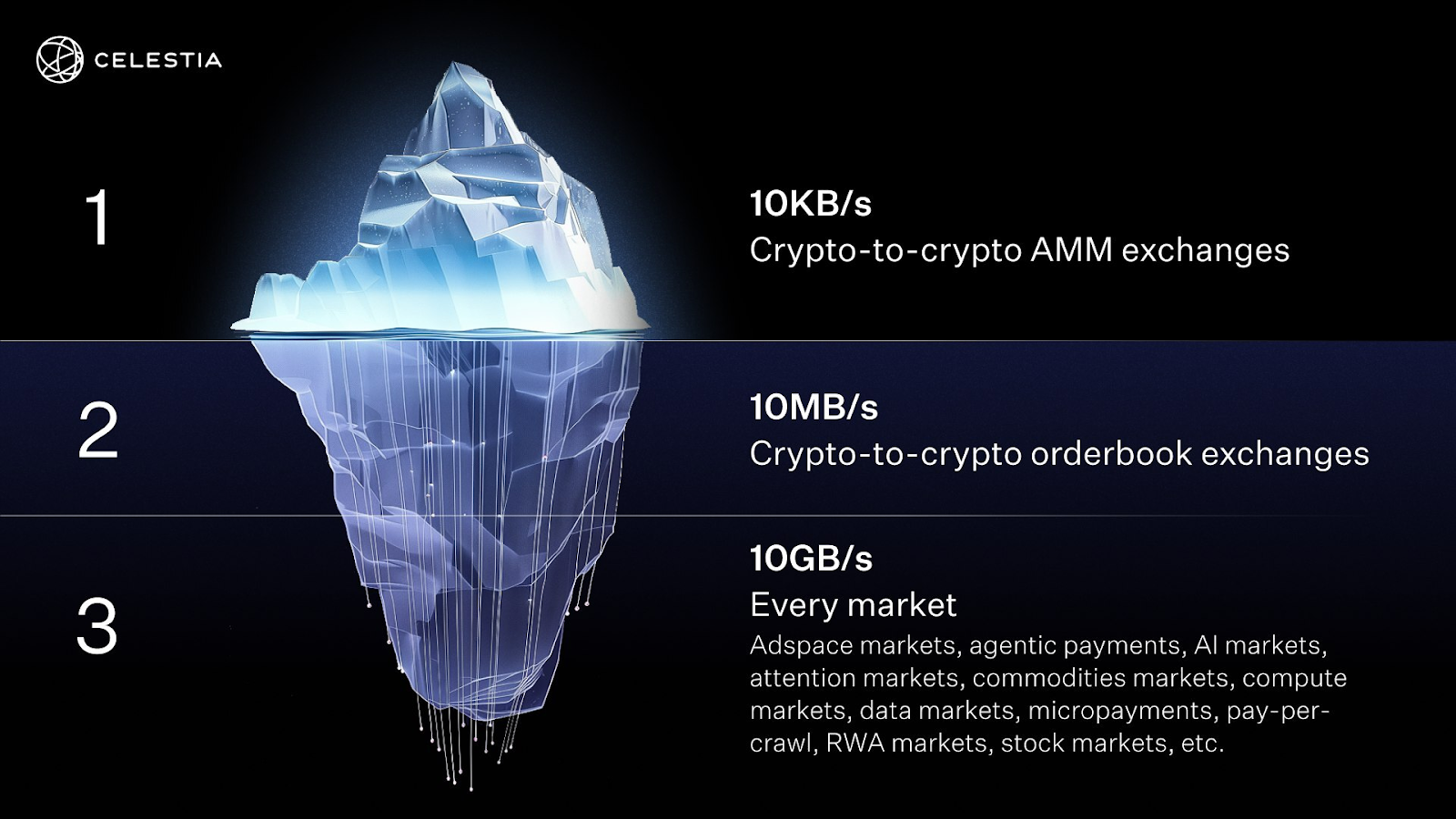
Some examples of markets that only make sense with highly abundant, cheap blockspace and millisecond latency:
- Adspace and attention markets
- Every page view can trigger a real-time onchain auction for impressions.
- Users can trade futures on website impressions, turning attention itself into a composable asset.
- Pay-per-crawl markets
- Instead of crawlers scraping the web for free, sites can advertise prices for being crawled by LLMs and agents.
- If AI chatbots replace search engines, this may be necessary as many content creators will no longer be able to monetize through ads directly.
- Agentic payments (HTTP 402/x402)
- Autonomous agents paying each other per API call, model query, or data fetch need HTTP-level latency and reliable micropayments. Chains on Celestia are effectively verifiable servers that enable this.
- Stocks and commodities markets
- Onchain markets make price discovery and trading for traditional assets more efficient and accessible, with permissionless read/write access to the underlying orderbooks.
- Micropayments for content and services
- Per-second streaming, per-article payments, per-API-call billing can be coordinated onchain instead of siloed subscription platforms.
- Fractionalised real estate and RWAs
- Deep, 24/7 secondary markets for tokenized assets with composable leverage, hedging and structured products.
- Onchain data markets
- Pay-per-query databases and cross-app data joins that monetise every read and write, powered by HTTP 402 micropayments.
Many of these use cases simply don’t work at L1 or “standard L2” prices or scale. They need highly abundant blockspace, which is what Fibre delivers.
How Fibre works
Fibre is a new data availability protocol run by the Celestia validator set, operating in parallel to the existing data availability protocol on the Celestia L1. Users can choose to submit blobs to either protocol, depending on their needs:
- Celestia L1 blockspace: the best option for new rollups that are still growing. No minimum blobsize, and a maximum blobsize of 8MB. Supports data availability sampling for use cases that need maximum end-user verifiability.
- Celestia Fibre blockspace: the best option for power-users and high-throughput rollups. 256KB minimum blobsize, and a maximum blobsize of 128MB.
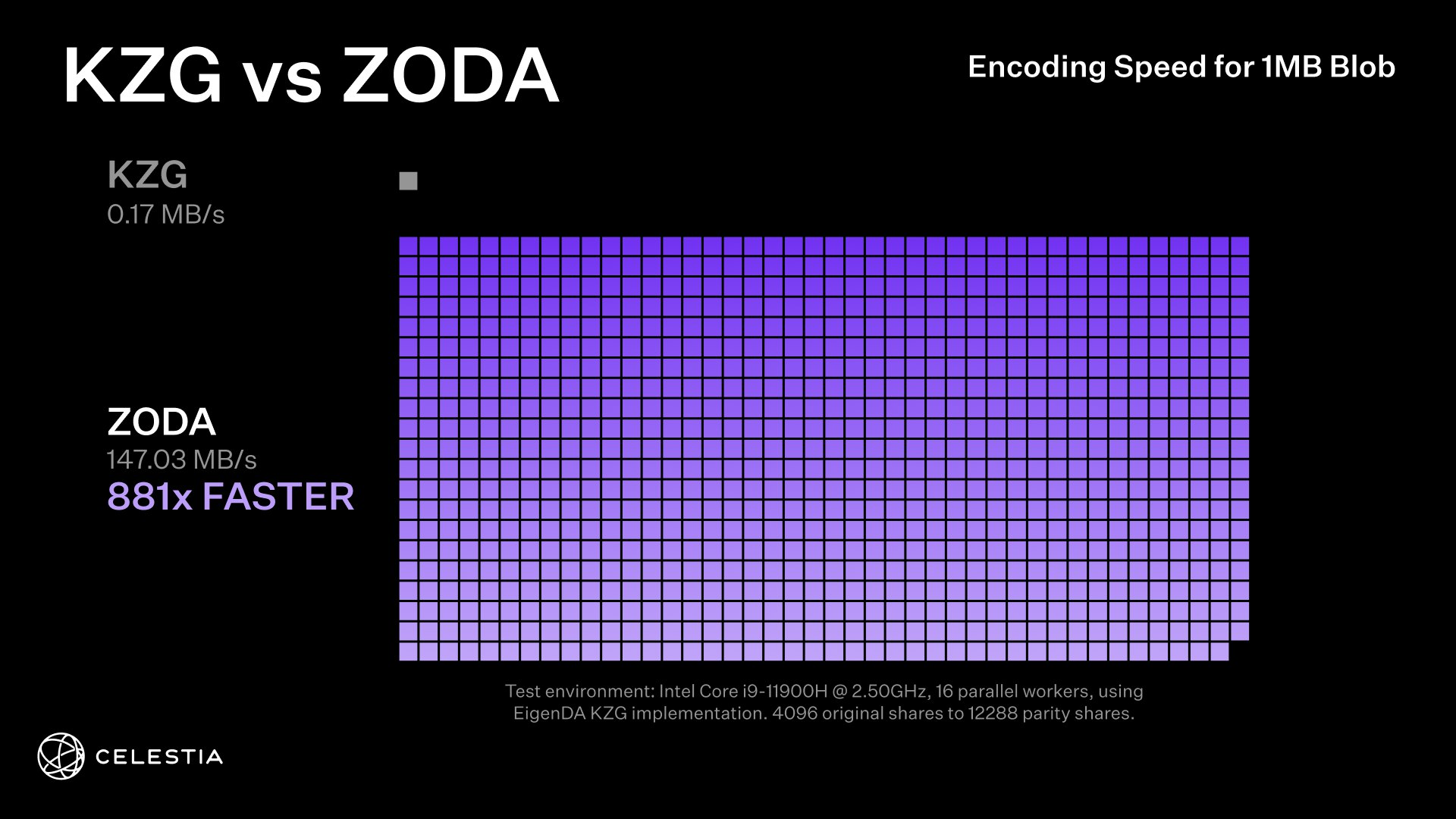
At the core of the Fibre protocol is a new ultra-fast data availability (DA) encoding protocol, based on ZODA. The encoding protocol provides an alternative to KZG commitments (used by existing DA protocols). Compared to KZG-based protocols, Fibre processes data up to 881x faster.
At a high level, the protocol works by users encoding their blob data and distributing the pieces directly to Celestia validators. The user then collects signatures from validators that confirm they have seen and stored the pieces. The signatures along with blob commitment are then submitted on the Celestia L1, where the Fibre fee is paid.
The ZODA-based encoding scheme allows the user to be sure that they can recover the blob from any ⅓ of honest validators.
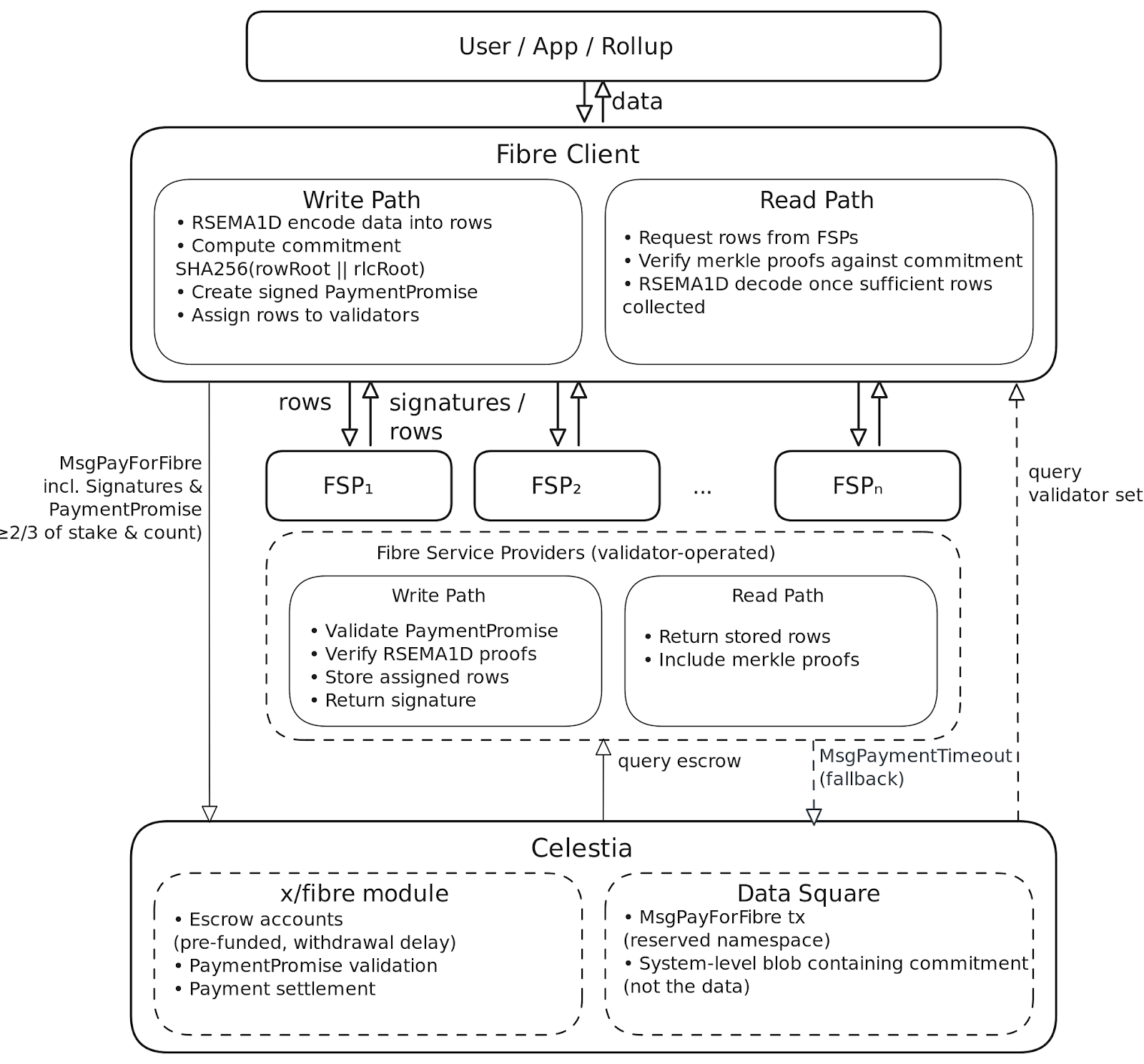
Further details can be found in the Fibre specification.
Benchmarking
1 Terabit per second of throughput was achieved during a large-scale test of the networking layer. A cluster of 498 GCP machines distributed across North America were used. The machines had between 48-64 vCPUs with 90-128GB of RAM, and were connected together with 34-45Gbps network links.
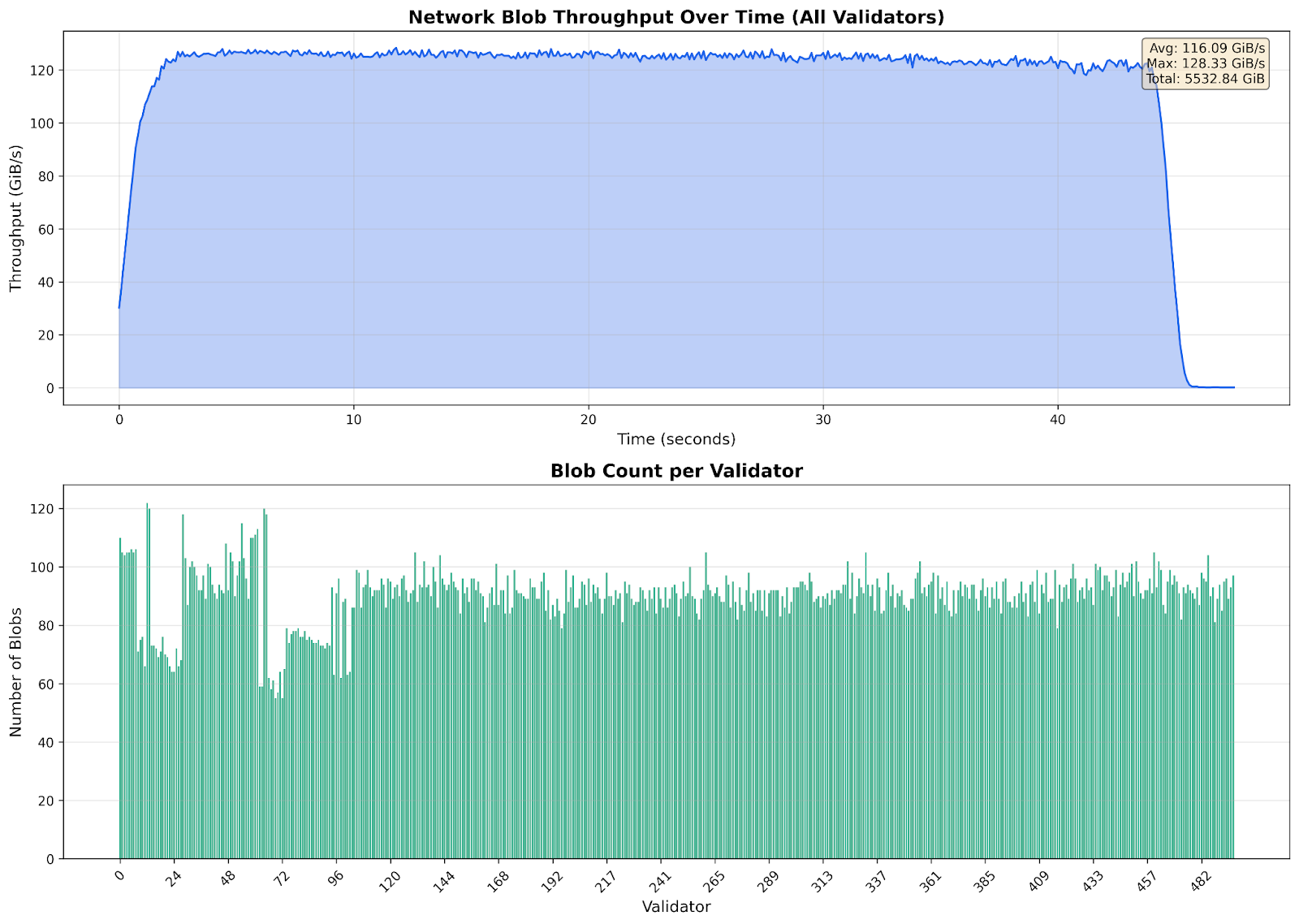
The code is now available with instructions to spin up a single node testnet locally.
What’s next
In the near future, the team will roll Fibre out to the Arabica testnet for developers to interact with. The entire protocol continues to undergo testing and preparation to be rolled out to mainnet, in incremental throughput increases.
Fibre delivers a throughput so enormous, it allows us to shift our focus from throughput bottlenecks to building products to make Celestia’s blockspace best in class. More on that soon.
Disclaimer
This post is for informational and discussion purposes only and does not constitute legal, financial, investment, or regulatory advice. The Celestia Foundation supports the development, furtherance and maintenance of decentralized software architectures and protocols or similar new open technology structures, in particular the Celestia network and protocol, and Celestia Labs provides blockchain infrastructure and software only and does not operate, sponsor, control, or intermediate any markets, trading venues, orderbooks, or financial products referenced herein. Any applications, markets, or protocols built using Celestia Labs’ technology are developed and operated by independent third parties, who are solely responsible for compliance with applicable laws and regulations.
Nothing herein constitutes an offer or solicitation to buy or sell any asset or to participate in any market. References to potential use cases involving financial instruments, real-world assets, derivatives, or other regulated activities are illustrative and aspirational only and do not imply regulatory approval or permissibility in any jurisdiction.
Statements regarding performance characteristics, scalability, throughput, latency, benchmarking results, or future capabilities reflect testing environments, design goals, and forward-looking expectations, not guarantees. Actual performance may vary materially depending on network conditions, configuration, and deployment context.
Forward-looking statements involve known and unknown risks, uncertainties, and assumptions, and actual results may differ materially. Readers should conduct their own independent evaluation and seek professional advice as appropriate.