Celestia Vision 2.0: every market onchain

0. Tl;dr
Mission: Build blockspace products that let high-volume markets come onchain.
Vision: Every market in the world trades on open infrastructure, with permissionless read and write access to every orderbook.
Principle: Social consensus is the final layer. Celestia provides infrastructure for markets that are fast enough for machines, but governable enough for humans.
Tagline: Fibre optic performance for millisecond markets.
Elevator pitch: Celestia is the L1 for custom onchain markets, enabling fibre-optic performance with millisecond latency.
1. From “more chains” to “more markets”
Celestia’s original mission was:
“Make deploying a rollup as practical as deploying a smart contract, so that every community and organisation can have its own sovereign chain.”
We were correct, directionally. Celestia was founded a year before Ethereum pivoted to a rollup-centric roadmap. Today there’s an ecosystem of Rollup as a Service (RaaS) providers and rollup frameworks, validating the thesis that blockspace should be modular and abundant.
But that vision stopped one layer up the stack. The question remained: what are all these chains actually for?
Which use cases will consume significant blockspace and generate real revenue, and how does TIA accrue value long-term?
Over the last few years, the answer has become clear:
Blockchains have product-market fit for markets.
AMM DEXes were the first proof.
Onchain perps and prediction markets are the second, with perps venues generating billions in annual revenue.
Stablecoins are the monetary base that ties it together. Yet, stablecoins are just the tip of the iceberg of the potential real world assets (RWA) market.
Recent infrastructure has enabled crypto-to-crypto orderbooks to live fully onchain. The next logical step is every other market: stocks, commodities, adspace, compute, data, AI, agentic payments, real estate, and things we haven’t imaged yet.
Celestia Vision 2.0 is about committing to that trajectory:
Celestia doesn’t just enable businesses to launch chains; we help them create markets.
2. Why all the markets are coming onchain
Today, only a handful of financial institutions have read and write access to the world’s orderbooks.
Retail traders are routed through opaque intermediaries (e.g. Robinhood via Citadel) who see and monetise their flow. High-quality market data is proprietary, and most people are price-takers, not first-class participants.
Onchain markets invert this while making them more economically efficient.
1. Market efficiency
Open access to liquidity supply, arbitrage, and new risk curves sharpens price discovery and makes capital more productive.
2. Permissionless 24/7 read and write access
Anyone (or any agent) can quote, trade, or build on top of shared, global orderbooks.
3. Composability and programmability
Markets become Lego blocks in a global state machine: agents and applications can interact with them natively via code and micropayments (HTTP 402/x402).
4. Equity and fairness
Access is no longer gated by geography, balance sheet, or broker relationships.
5. Policy shift
U.S. regulators and policymakers have publicly discussed tokenization as a potential future component of market infrastructure, with ongoing debate around how existing regulatory frameworks may evolve.
Moving markets onchain makes them more economically efficient and equitable. That is a big enough “why” for a decade-long mission.
3. The throughput iceberg: from 10KB/s to 1Tbps
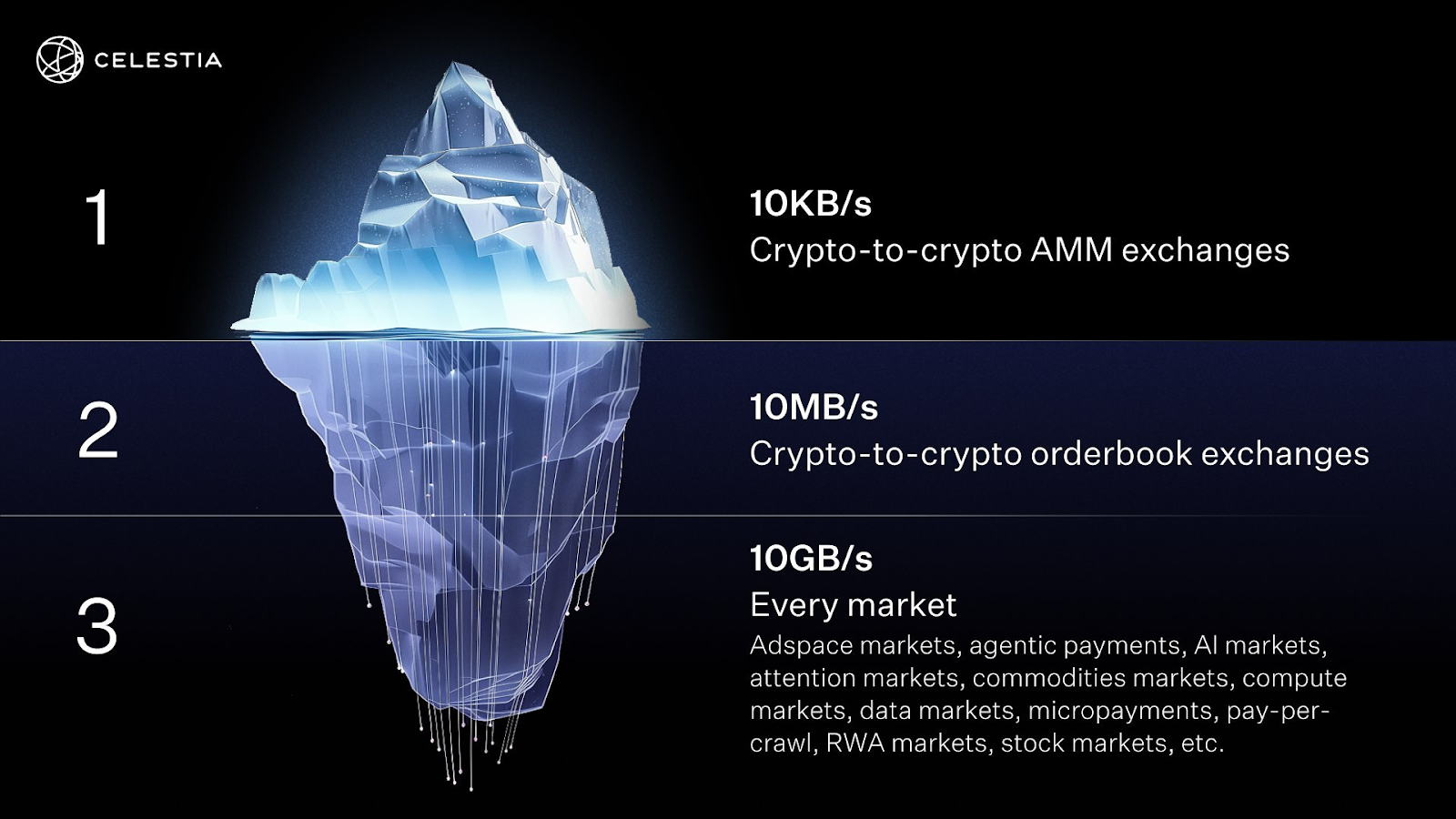
The last decade of onchain market design can be described in three bandwidth regimes:
1. 10KB/s - AMM era
The first era was enough for AMM-based spot markets on monolithic L1s. This enabled permissionless market creation, but with high latency and limited expressiveness. These markets weren’t as competitive as centralised exchanges with orderbook-based markets.
2. 1 - 10MB/s - onchain orderbook era
The second era was enough for central limit orderbooks (CLOBs) and perps DEXes for trading crypto assets.
Celestia 1.0 lives here: our blockspace throughput makes onchain orderbooks viable, but only for a narrow set of markets, specifically crypto-to-crypto markets.
3. 1GB/s - 1Tbps - “everything markets” era
The next era is enough to put every market onchain, not just crypto-to-crypto markets. This includes markets that write for every impression, every crawl, or every agent action.
This is where Fibre takes us.
When Celestia launched, there was scepticism around the need for abundant blockspace. We now see that perps dexes like Hyperliquid (as well as Bullet and VEX) have blockspace needs of over 10MB/s. This is orders of magnitude more than what speculators thought was needed (the endgame of the full Danksharding roadmap only provides 0.67MB/s).
Now, MB/s is a minimum requirement for ambitious onchain markets, and within a few years, GB/s may well be the new minimum requirement.
If 10KB/s enabled AMMs, and 10MB/s enabled onchain orderbooks, then 1 Tbps is the leap that enables every market to come onchain - roughly 1 transaction per second for every human on earth, or for every agent they own.
4. Fast enough for machines, governable enough for humans
Fibre’s 1Tbps is the first bandwidth regime where markets stop being “apps” and start being a primitive - something that can run at the speed of the internet, for everything from finance to attention to data.
Within a few decades, I expect a majority of economic activity to be machine-to-machine: autonomous AI agents trading with each other at API speed. Most assets and capital may be owned and controlled by agents, not humans.
In that world, blockchains are no longer just “rails” for humans. They become the substrate for AI lifeforms - a shared, verifiable state machine for machine civilisation. Agents will use blockchains to own and transfer assets, and smart contracts will be how agents “incorporate” and coordinate their organisations.
However, the future can end up in two ways:
- Dystopia: agents accrue unchecked power over humans in a hyper-financialised society that paperclip-optimises for profit, at the expense of humans.
- Utopia: an AI-operated free market economy that is constrained by human values and exists to serve humans, producing abundance and freeing humans from material scarcity.
The difference won’t be whether AI happens, but whether humans retain credible control over the rules.
To steer towards the utopian version, we have to reject “code is law” absolutism. Markets are social systems; their rules must remain legible, enforceable and upgradeable by humans - even when machines become the dominant participants. This is also why tokenholder governance is insufficient as the final layer: in an agentic economy, stake-weighted voting is legible to machines and capturable by machines.
Blockchains are community-owned computers whose ledgers have meaning because a community collectively wills them into existence via a social contract - and that same social consensus can amend rules via hard forks when reality changes.
For Celestia, and the sovereign markets built on it, that implies two non-negotiable system design principles:
1. Off-chain governance trumps token-holder governance
“We reject kings, presidents and voting. We believe in rough consensus and running code.” - David D. Clark, IETF
The canonical fork - and therefore the canonical rules of the protocol - are defined by the social layer and ecosystem, not by token voting, validators, whales, or automated capital.
This is the only credible way to preserve a human “escape hatch” in a world where machines can out-compete humans economically: humans must be able to coordinate a rules upgrade (or a fork) if any agent or systems accumulate too much power or violate core social constraints.
Celestia hardcodes this principle into its upgrade system: the chain removes the standard Cosmos SDK upgrade functionality so the onchain governance module cannot schedule upgrades; upgrades require offchain agreement on upgrade logic and height.
This is exactly why sovereign rollups matter at the market layer: the canonical chain is determined by the rollup’s own nodes (not an enshrined settlement contract), preserving an upgrade path that can acknowledge social-consensus hard forks.
2. Users are first-class citizens of the network
If humans are going to remain meaningfully in charge of machine-speed markets, they need the ability to verify what the network is doing directly, without trusting centralised endpoints, committees, or gatekeepers.
That means prioritising trust-minimised light nodes so that verification is accessible - eventually, to something you can run on a phone. Celestia prioritises trust-minimised light nodes that let users verify correctness using Data Availability Sampling (DAS).
Social consensus is the final layer. We should build infrastructure that is fast enough for machines, but governable enough for humans.
5. Why these markets will be custom chains (and why they need Celestia)
High-volume markets don’t behave like normal apps. They’re real-time systems where every millisecond matters, the event stream is enormous (quotes, cancels, matches, liquidations, API calls), and the business model depends on tight control over fees, incentives, and execution rules.
That’s why over the last two years, many of the most ambitious “apps” didn’t stay as apps at all - they launched their own high-performance networks when shared chains couldn’t meet their latency, throughput, or business requirements.
Celestia’s thesis is that the default path shouldn’t be “go build an entire L1”. The default path should be: launch a dedicated market chain, and plug it into abundant, neutral blockspace.
There are three realistic architectures a serious market can choose from:
1. Deploy on a shared execution chain (Solana/Base/monolithic L1s)
Why teams choose it:
- Fastest to ship.
- Shared liquidity and distribution.
- Simple operationally - you’re “just an app.”
Why it doesn’t work for demanding markets:
- Markets share an execution environment with noisy neighbours: congestion, priority fee wars, and unpredictable execution/latency at the exact moment markets are stressed.
- Markets can’t always fully tailor the execution environment to its needs (risk engine, orderbook layout, fee and rebate logic).
- Markets leak economic value: fees, MEV policy, and infrastructure “rent” are constrained by the host chain.
Shared execution is great for many apps, but it’s a poor home for the most latency-sensitive, highest-volume markets.
2. Run its own execution on a rollup chain, but use Ethereum blobs (or a low-throughput DA stack)
Why teams choose it:
- Strong perceived neutrality/alignment.
- Familiar ecosystem and tooling.
Why it doesn’t work for demanding markets:
- Blockspace constraints become binding as you approach “write for every event” workloads, and markets end up optimising around the DA layer’s limits rather than the market’s needs.
3. Build a standalone L1 just for the market
Why teams choose it:
- Full control over performance, economics, and roadmap.
The hidden cost:
- Building an L1 is like building a data centre before you build your business. To get credible liveness, markets need a large distributed validator set and ongoing ecosystem spend to keep validators economically viable and aligned.
- L1s need a token that is “money for security” first - which usually means inflating the token to pay a validator set, even if that’s not what the market actually needs.
- L1s get significantly worse (preconf) latency than a market running on a single-sequencer rollup chain that inherits security from a shared blockspace layer.
- You also take on years of engineering risk - consensus, networking, upgrades, monitoring, incident response - before even proving product-market fit.
The Celestia path: launch a market chain on shared blockspace
Celestia lets markets get the benefits of a dedicated chain without paying the “build an L1” tax. A Celestia-enabled market chain gives you:
- Dedicated performance: custom execution tuned for the market’s matching engine, risk, and latency profile.
- Massive scale headroom: abundant blockspace designed for high write throughput.
- Full-stack economics: the market keeps control over fee design, incentives, and market structure - without being forced into a host chain’s rent model.
- Cleaner token design: the token can be used for market incentives, utility, and alignment, rather than primarily for subsidising a validator set to access blockspace.
- Faster time-to-production: ship a custom chain in weeks (or less), not after a multi-year L1 build.
Under the hood, these market chains are rollups: verifiable servers that post data to Celestia’s blockspace for security, verifiability and decentralisation.
If the most important markets will demand sovereignty, performance, and control - but won’t want to reinvent consensus and blockspace - then Celestia becomes the shared foundation that serious markets standardise on.
6. Markets that 1Tbps unlocks
Some examples of markets that only make sense with highly abundant, cheap blockspace and millisecond latency:
- Adspace and attention markets
- Every page view can trigger a real-time onchain auction for impressions.
- Users can trade futures on website impressions, turning attention itself into a composable asset.
- Pay-per-crawl markets
- Instead of crawlers scraping the web for free, sites can advertise prices for being crawled by LLMs and agents.
- If AI chatbots replace search engines, this may be necessary as many content creators will no longer be able to monetize through ads directly.
- Agentic payments (HTTP 402/x402)
- Autonomous agents paying each other per API call, model query, or data fetch need HTTP-level latency and reliable micropayments. Chains on Celestia are effectively verifiable servers that enable this.
- Stocks and commodities markets
- Onchain markets make price discovery and trading for traditional assets more efficient and accessible, with permissionless read/write access to the underlying orderbooks.
- Micropayments for content and services
- Per-second streaming, per-article payments, per-API-call billing can be coordinated onchain instead of siloed subscription platforms.
- Fractionalised real estate and RWAs
- Deep, 24/7 secondary markets for tokenized assets with composable leverage, hedging and structured products.
- Onchain data markets
- Pay-per-query databases and cross-app data joins that monetise every read and write, powered by HTTP 402 micropayments.
Many of these use cases simply don’t work at L1 or “standard L2” prices or scale. They need highly abundant blockspace, which is what Fibre delivers.
7. What Celestia builds: the market stack
Celestia is the infrastructure for bespoke onchain markets. That means shipping blockspace products that are:
- Mission critical - markets go down if the Celestia network goes down.
- Differentiated - Celestia offers something no other blockspace provider/L1 can.
- Profitable - capable of supporting high margins, like the modern cloud.
We can frame Celestia’s product pillars as what onchain markets need:
Fibre: markets need abundant, reliable blockspace
1 Tbps of blockspace with simple, reliable submission APIs and predictable fees. This is the foundation that makes the other pillars possible at global scale.
Private Blockspace: markets need confidentiality
Dark pools, private orderflow, institutional size orders, and privacy-preserving strategies need confidential transactions. Private blockspace and encryption-aware tooling are important differentiators.
Interop: markets need liquidity
Markets thrive when capital and users flow freely between them. Lazybridging, cross-chain messaging, and Celestia-native asset routing make chains feel like different venues on the same global exchange.
Frameworks: markets need customisation, low latency, and scale
Rollup chains are verifiable servers: they can be tuned for specific markets, execution models and latency profiles. Celestia-native frameworks like Sovereign SDK and Evolve let builders design chains that are ruthlessly opinionated, with full-stack control of execution and economics.
Programmable liquidity: markets need programmability
Markets need a fast, programmable coordination layer that compresses latency, lowers the cost of intents, and concentrates liquidity across rollups, while also serving as a high-performance launchpad for emerging markets.
8. A meaningful revenue story for TIA
Targeting onchain markets makes TIA’s value accrual much clearer. Exchanges and trading venues are some of the highest-revenue businesses. If Celestia powers markets that collectively generate $20B of revenue annually (Binance scale), then a 3% “take rate” on that flow is $600M per year in blockspace revenue.
A 3% take rate is modest considering that:
- The public cloud sector already generates hundreds of billions of dollars in annual revenue ($669B in 2023 alone).
- a16z’s analysis shows that for many scaled software companies, cloud spend can be ~50% of the cost of revenue.
- Cloudflare’s breakdown of AWS egress fees shows markups of several hundred percent on bandwidth relative to underlying network costs - a stark example of what happens when you provide critical infrastructure.
Blockspace has similar economics: once the protocol is built and secured, incremental bandwidth can be very high margin, if the apps that use it actually have meaningful revenue.
If Celestia is the main credible provider of reliable, high-throughput, specialised blockspace for millisecond markets, it can sustain a healthy revenue, especially if it makes its blockspace sticky through value-added features (privacy, interop, frameworks) that markets can’t easily get elsewhere.
A realistic mid-term target is $50m/year in protocol revenue, which assumes a ~5% take rate on a ~$1B revenue market on Celestia (Hyperliquid scale), on the way to the $600M+ horizon.
9. Strategic priorities for the next two years
Unlike AWS, which launched into a booming Web2 ecosystem, we’re building for use cases that are mostly still speculative. This is both Celestia’s risk and its advantage. It means that Celestia must simultaneously:
- Win today’s markets - perps, prediction markets, stablecoin infra.
- Shape tomorrow’s markets - adspace, pay-per-crawl, AI/agent rails, tokenized financial markets, onchain DBs.
To do that, we need to change how we go to market and what we build:
1. Become the strategic partner for high-volume market builders
We move from “selling blockspace” to co-designing the entire stack for Celestia’s most important users, and treat top prospects as co-researchers and long-term partners rather than DA buyers. We help them solve real problems with latency, custom execution, privacy, fee design, and full-stack control, not just “where do I publish blobs”.
The best teams want to own their own stack and keep control over their economics. Celestia’s value is giving them the primitives and guarantees they need to do that faster, safer, and better than building everything from scratch.
Concretely, this means a white-glove BD approach with engineers in the loop, shared architecture reviews and roadmap alignment with key markets, and a selective focus on customers who can move the needle on volume and revenue, not just long-tail experiments.
2. Verticalise around blockspace to make Celestia irresistible and sticky
Celestia’s products should make Celestia’s blockspace the obvious, irresistible choice. As mentioned above, this includes private blockspace, interop primitives, and Celestia-native chain frameworks.
This doesn’t mean Celestia turns into a heavy, monolithic provider, but it means it curates the pieces that are the most mission-critical for markets and integrate them tightly.
3. Make blob submission boringly reliable
Our core product currently is still blockspace. Getting high throughput from Celestia’s blob APIs has been non-obvious, often leading to a rough developer experience.
With Fibre, Celestia has the chance to reset the standard with simple, well-documented read and write APIs that “just work” at high throughput, with clear performance guarantees and observability.
If Celestia is to be the infrastructure for millisecond markets, its infrastructure must feel like fibre optic rather than dial-up.
4. Revisit blob pricing: from “basically free” to sustainable economics
Right now, Celestia’s blockspace is underpriced or mispriced. Celestia blockspace is basically free as it’s set to a minimally low fee to prevent spam rather than trying to make revenue. This is because Celestia is currently optimising for growth rather than revenue, and revenue is downstream of having high revenue-generating apps that use Celestia in the first place.
However, as Celestia grows, it will become important to have a blockspace pricing model that generates meaningful protocol revenue while keeping marginal costs low for high-throughput rollups. The “On Data Availability Pricing” proposal outlines one possible direction, using a volume-tiered pricing model.
We should treat blockspace pricing as a core product surface, rather than a static parameter.
10. Call to arms
In five years, one of two things will be true:
1. Onchain markets will still be a niche for crypto-to-crypto trading.
2. Or they will be the substrate for how AI, humans, and organisations transact for everything: compute, data, attention, money, and real-world assets.
Celestia exists to make the second future happen.
We have the technology to achieve 1Tbps of blockspace, a clear thesis that markets (and not just generic dapps) are what will consume it, and an opportunity to be the leading blockspace player in the millisecond market stack.
Mission: Build blockspace products that let high-volume markets come onchain.
Vision: Every market in the world trades on open infrastructure, with permissionless read and write access to every orderbook.
Principle: Social consensus is the final layer. Celestia provides infrastructure for markets that are fast enough for machines, but governable enough for humans.
Tagline: Fibre optic performance for millisecond markets.
Elevator pitch: Celestia is the L1 for custom onchain markets, enabling fibre-optic performance with millisecond latency.
If we execute, Celestia won’t just be “another L1”. It will be the infrastructure that all the world’s markets run on.
Let’s build that future.
Disclaimer
This post is for informational and discussion purposes only and does not constitute legal, financial, investment, or regulatory advice. The Celestia Foundation supports the development, furtherance and maintenance of decentralized software architectures and protocols or similar new open technology structures, in particular the Celestia network and protocol, and Celestia Labs provides blockchain infrastructure and software only and does not operate, sponsor, control, or intermediate any markets, trading venues, orderbooks, or financial products referenced herein. Any applications, markets, or protocols built using Celestia Labs’ technology are developed and operated by independent third parties, who are solely responsible for compliance with applicable laws and regulations.
Nothing herein constitutes an offer or solicitation to buy or sell any asset or to participate in any market. References to potential use cases involving financial instruments, real-world assets, derivatives, or other regulated activities are illustrative and aspirational only and do not imply regulatory approval or permissibility in any jurisdiction.
Statements regarding performance characteristics, scalability, throughput, latency, benchmarking results, or future capabilities reflect testing environments, design goals, and forward-looking expectations, not guarantees. Actual performance may vary materially depending on network conditions, configuration, and deployment context.
Forward-looking statements involve known and unknown risks, uncertainties, and assumptions, and actual results may differ materially. Readers should conduct their own independent evaluation and seek professional advice as appropriate.